报告讲稿Seminar
面向不认识本项目的研究生与教授的 45 分钟报告;每页幻灯片下面附完整讲稿(双语),打印视图将两者合排。A 45-minute talk for graduate students and professors who do not know the project; the full script sits under every slide (bilingual), and the print view puts the two together.
核心贡献一句话:XMM-Newton 点源检测似然比的条件宽度可以零参数地写出,其目录区间的偏窄由一个机制解释——两个几乎相消的大项中约 1 % 的 penalty 错配被相消放大成 8–16 % 的方差高估——且该机制同时决定我们自己的拟合器与 emldetect 两条流水线的宽度;在 emldetect 输出上,条件规律的四个候选形式被一支验证过的评分器全部拒收;2026-10-21 的复核(R114)进一步表明评分器混用了估计对象,所以"宽度可推广"只能读作在同一个位置内——宽度指标对逐位置偏移恒等不变;PI 的进度指标也改为已解决位置的比例(无阈值)。2026-10-22 的复核又把判据本身校准了一次:“每个条目都在容差 \(\varepsilon\) 内”被证明噪声受限(一条完美规律在能段 4 上也只能让 21–27 % 的位置满足它),判据因此改为每个位置一个合并偏移,容差定为比较规律 0.05、跟踪进度 0.10;打分手随之冻结。旧读数“规律就压在位置盲地板上”被地板改正推翻,改正后最好候选在 0.10 处高于地板;位置效应的来源收窄到像素级几何且两条能段共享;第一个拟合前位置项(拟合盒背景水平)把最好候选从 0.545 抬到 0.727(p 0.003–0.004,尚未在新位置检验)。宽度侧,判据也被校准——一条逐行精确的方差律通过“8 箱全在 1 \(\pm\) 0.02 内”的概率只有 66.8 %,PI 于是批准“8 箱允许 1 箱失败”(完美规律通过约 95 %);在这条判据下第一条可观测箱级宽度规律通过,但带宽在测试半上选定,且同一构造迁到 emldetect 行后在全统计量下仍失败 5/5 箱。冻结打分手的宽度区间仍欠覆盖(0.941 / 0.946 对 0.950 的接受带),所以每个已解决比例都要连这个限制一起引用。2026-10-24 的第一臂更新:普适性 Tier 1 第一臂(留出能段块打分)已出:M2 能段 1 中心确认(0.727,区间 [−0.152, +0.061]),宽度旗标 AMBIGUOUS(超出真实、单侧约 2 %,但箱边一移判定就翻),锚 8/12;没有合并判定。背景通道给出一条新的未决依赖:冻结定律在估计背景下偏 +0.174 z,候选参数 C2 暂定于一个观测;代价锚实测 0.97 CPU-s/行(旧 0.4 作废),T1-a 只跑 M2 并已发射。星表侧:DET_ML 有序残差是标注同义反复;断幂律 5/6、eta 振幅修合并宽度但逐格形状失败。Central contribution in one sentence: the conditional width of the XMM-Newton point-source detection likelihood ratio can be written down with zero fitted parameters, its catalogue-interval narrowing is explained by one mechanism — a roughly 1 % penalty mismatch in one of two nearly cancelling large terms, amplified by the cancellation into an 8–16 % variance over-statement — and that one mechanism carries the widths of both our own fitter and emldetect; on emldetect output, four candidate forms of the conditional law are all rejected by a validated scorer; a 2026-10-21 audit further shows the scorer mixed estimands, so "the width generalises" reads only as within one position — the width metric is identically invariant to per-position offsets; and the PI's progress metric became the solved fraction of positions, with no threshold. A 2026-10-22 audit then re-calibrated the criterion itself: the “every entry within the tolerance \(\varepsilon\)” rule was shown to be noise-limited (even a perfect law satisfies it at only 21–27 % of positions on band 4), so the criterion became one pooled offset per position, with tolerances of 0.05 to compare laws and 0.10 to track progress; the scorer was frozen with it. The old reading “the laws sit at the position-blind floor” is overturned by the floor correction, after which the best candidate sits above the floor at 0.10; the position effect's origin narrowed to pixel-level geometry shared by both bands; and a first pre-fit position term (the fit-box background level) lifts the best candidate from 0.545 to 0.727 (p 0.003–0.004, not yet tested on fresh positions). On the width side the criterion was calibrated too — a row-exact variance law passes “all 8 bins inside 1 \(\pm\) 0.02” only 66.8 % of the time, so the PI approved “at most 1 failing bin of 8” (a perfect law passes about 95 %); under it the first observable bin-level width law passes, but its bandwidth was chosen on the test half and the same construction still fails 5/5 bins on emldetect rows at full statistics. The frozen scorer's width interval still under-covers (0.941 / 0.946 against a 0.950 acceptance band), so every solved fraction must be quoted with that limit attached. The 2026-10-24 first-arm update: Universality Tier 1's first arm (the held-out band-block scoring) has reported: M2 band 1's centre is confirmed (0.727, interval [−0.152, +0.061]), the width flag is AMBIGUOUS (the excess real, one-sided about 2 %, but the verdict flips with the bin edges), the anchor 8/12; there is no combined verdict. The background channel adds a new unresolved dependency: the frozen law is off by +0.174 z under an estimated background, with the candidate parameter C2 provisional on one observation; the cost anchor is measured at 0.97 CPU-s/row (the old 0.4 superseded), and T1-a runs M2 only and has been launched. On the catalogue side: the DET_ML-ordered residual is a labelling tautology; the broken power law is 5/6, and the eta amplitude restores the pooled width while the per-cell shape fails.
你从目录里拿到的每一个误差棒,都假设了一个条件宽度Every error bar you take from a catalogue assumes a conditional width
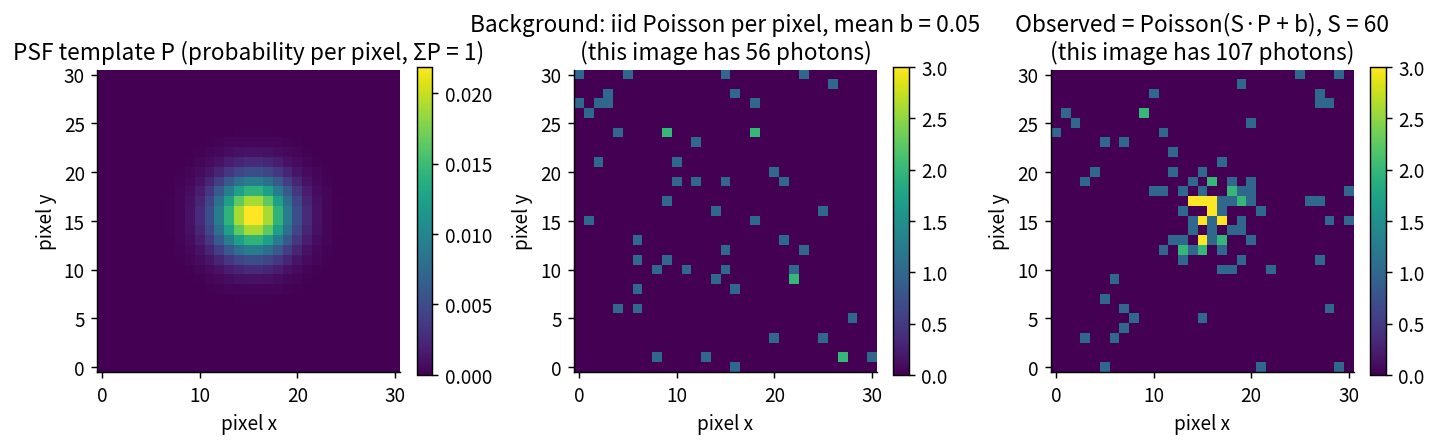
一张 XMM 图像 = 源(PSF 加权)+ 背景(逐像素泊松)。检测把这张图折成一个数。An XMM image = source (PSF-weighted) + background (Poisson per pixel). Detection folds this image into one number.
先说为什么这个问题值得四十五分钟。你从 XMM 目录里拿一个源,目录给你三样东西:计数、误差棒、完备性。这三样最终都压在同一个量上——给定你测到的计数和背景,检测统计量围绕它的条件均值散开多宽。宽度偏窄,误差棒就偏小,完备性就偏高,你以为探测到的源比实际多;宽度偏宽,反过来。所以条件宽度是目录可信度的底层量。看这张图:左边是 PSF 模板——源光子落在哪里;中间是均匀背景,每像素独立泊松;右边是两者相加,就是你拿到的观测图像。检测要做的,是把右边这张图折成一个数。我们的问题等价于:这个数对它的期望值会抖多宽。
First, why this problem deserves forty-five minutes. Take a source from an XMM catalogue: it hands you three things — counts, an error bar, a completeness. All three rest on one quantity: given the counts you measured and the background you measured, how widely does the detection statistic scatter around its conditional mean? If the width is narrow, the error bars are small and the completeness is high — you believe you have more real detections than you do. If it is wide, the reverse. The conditional width is therefore the quantity underneath catalogue reliability. Look at the figure: on the left the PSF template — where the source's photons land; in the middle the flat background, an independent Poisson draw per pixel; on the right the sum, which is the image you actually get. Detection has to fold the right-hand image into one number. Our question is equivalent to asking: how widely does that number jitter around its expectation.
cumulative 3.0 min
教科书说 \(\Delta C\) 应该是 \(\chi^2_3\)——但目录恰恰关心它最不可信的地方The textbook says \(\Delta C\) should be \(\chi^2_3\) — but catalogues care exactly where that is least reliable
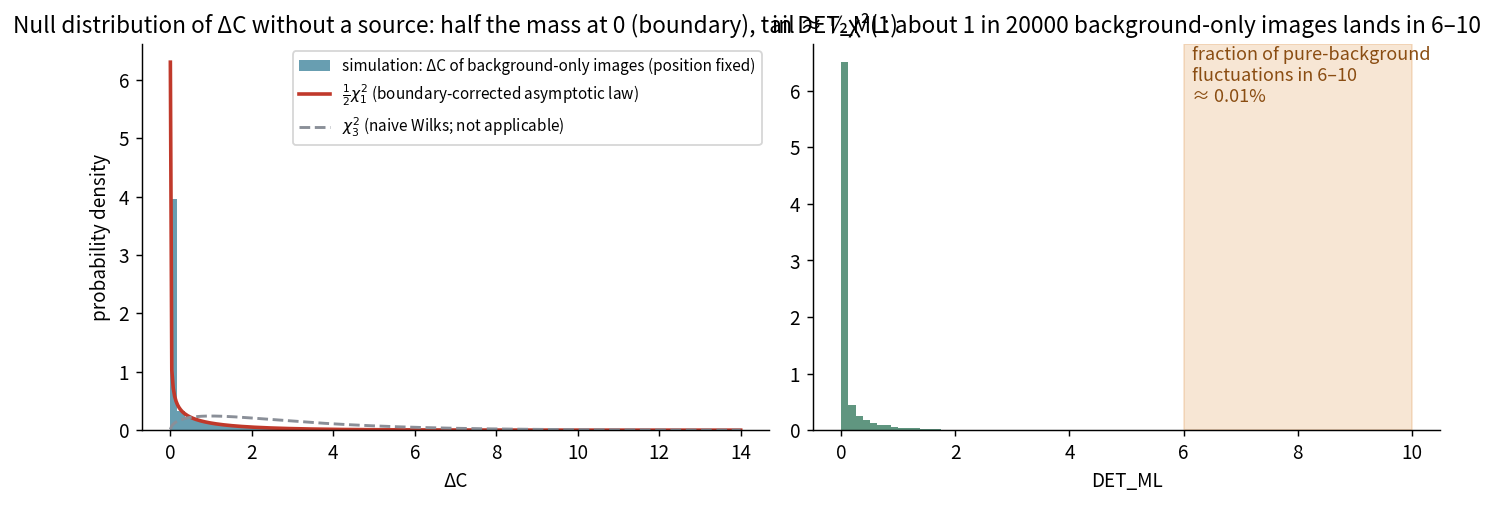
纯背景模拟的 \(\Delta C\) 分布:朴素 Wilks 的 \(\chi^2_3\)(灰虚线)明显不对;边界修正后的渐近律(红)才对。[s2]The \(\Delta C\) distribution of pure-background simulations: naive Wilks \(\chi^2_3\) (grey dashed) is clearly wrong; the boundary-corrected asymptotic law (red) is right.[s2]
教科书怎么说?Wilks 定理:光子足够多时,Delta C 渐近趋向自由度三的卡方。听起来问题已经解决了——但看这张直方图。横轴是 Delta C,纵轴是行数;灰虚线是教科书给的卡方三,红实线是边界修正后的渐近律,直方图来自两万张纯背景模拟图像。你可以直接看到两件事:一半质量贴在零上——没有源时最优位置是随机的,一半的实现给出 Delta C 恰好为零;尾部跟卡方三完全不是一回事。正确的渐近是边界修正过的形式。目录恰恰关心弱源——几十个光子、检测似然六到十——那里似然面远离二次型,渐近论证最不可靠。所以宽度必须在模拟里逐箱测量,不能从定理直接搬。
What does the textbook say? Wilks' theorem: with enough photons, Delta C converges to a chi-squared with three degrees of freedom. That sounds like the problem is solved — but look at this histogram. The horizontal axis is Delta C, the vertical axis the number of rows; the grey dashed curve is the textbook chi-squared-three, the red solid curve the boundary-corrected asymptotic law, and the histogram is built from twenty thousand pure-background simulated images. You can see two things directly. Half the mass sits at zero — with no source present the best-fit position is random, and half the realisations give Delta C exactly zero. And the tail is nothing like chi-squared-three. The correct asymptotic is the boundary-corrected form. Catalogues care precisely about the faint regime — a few tens of photons, detection likelihood between six and ten — where the likelihood surface is far from quadratic and the asymptotic argument is least reliable. So the width has to be measured bin by bin in simulation; it cannot be transplanted from the theorem.
cumulative 9.0 min
条件化决定一切:理论只能条件于可观测量 \((\hat{S}, b)\),永远不能条件于模拟标签Conditioning decides everything: theory may condition on the observables \((\hat{S}, b)\), never on the simulation label
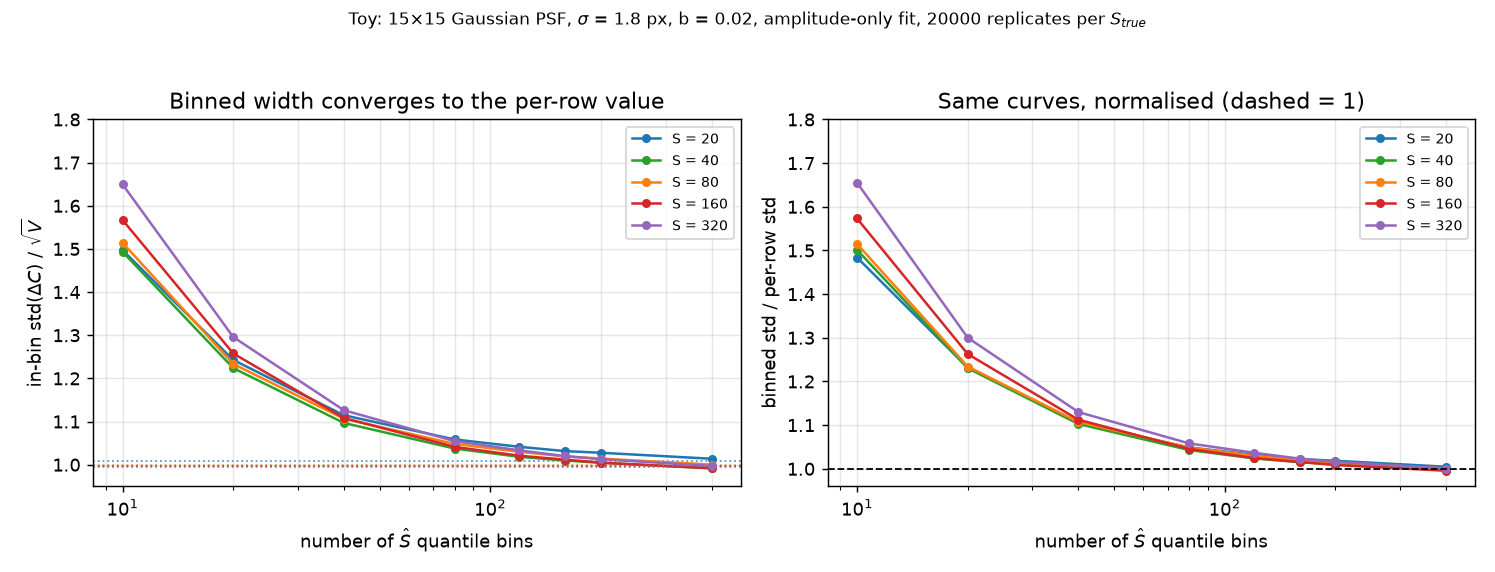
按 \(\hat{S}\) 分箱会把宽度测胖:20 箱读 1.22–1.30,200 箱收敛到逐行值 1.005–1.028。[s3]Binning in \(\hat{S}\) fattens the measured width: 20 bins read 1.22–1.30, 200 bins converge to the per-row value 1.005–1.028.[s3]
讲结果之前,必须先立一条铁律,因为它决定所有数字怎么读。真实流量是模拟的标签,目录用户拿不到它;用户手里只有两个可观测量:测到的计数和背景。所以一切理论必须条件在可观测量上,永远不能条件在真实流量上。这张图是这条铁律救过我们一次的例子。横轴是分箱数——把样本按测到的计数切成多少格;纵轴是格内残差的标准差除以插入式宽度。左图是绝对值:每条彩色曲线对应一个真实流量,点状横线是它的逐行值。你可以看到分箱越少,读数越胖:二十个箱读出一点二二到一点三零,两百个箱收敛到一点零零五到一点零二八。右图把每条曲线除以自己的逐行值,收敛线统一落在一点。所以早期那个“插入式窄百分之二十二到三十”的读数,是分箱自己造出来的,后来正式撤回。今天我引用的每一个宽度,都是按可观测量分箱、逐行条件化测出来的。
Before the results, one rule has to be established, because it decides how every number in this talk is read. The true flux is a label attached by the simulation; a catalogue user never has it. What the user has are two observables: the measured counts and the background. So all theory must condition on observables, never on the true flux. This figure is an example of the rule saving us once. The horizontal axis is the number of bins — how finely the sample is sliced in the measured counts; the vertical axis is the in-bin residual standard deviation divided by the plug-in width. In the left panel, absolute values: each coloured curve is one true flux, and the dotted horizontal line is that flux's per-row value. You can see that fewer bins read fatter: twenty bins give one point two two to one point three zero, two hundred bins converge to one point zero zero five to one point zero two eight. The right panel divides each curve by its own per-row value, so the convergence line sits at one. The early reading that "the plug-in is narrow by twenty-two to thirty per cent" was therefore created by the binning itself, and was formally withdrawn. Every width I quote today is measured in observable bins, conditioned row by row.
cumulative 11.0 min
已有的经验校准路线给得出“差多少”,给不出“为什么”Existing empirical-calibration routes can tell you "how much" but not "why"
重复指向 / 注入源:仪器、背景、源群、流水线同时变——四个因子纠缠在一起。Repeat pointings / injected sources: instrument, background, source population and pipeline all change at once — four factors entangled.
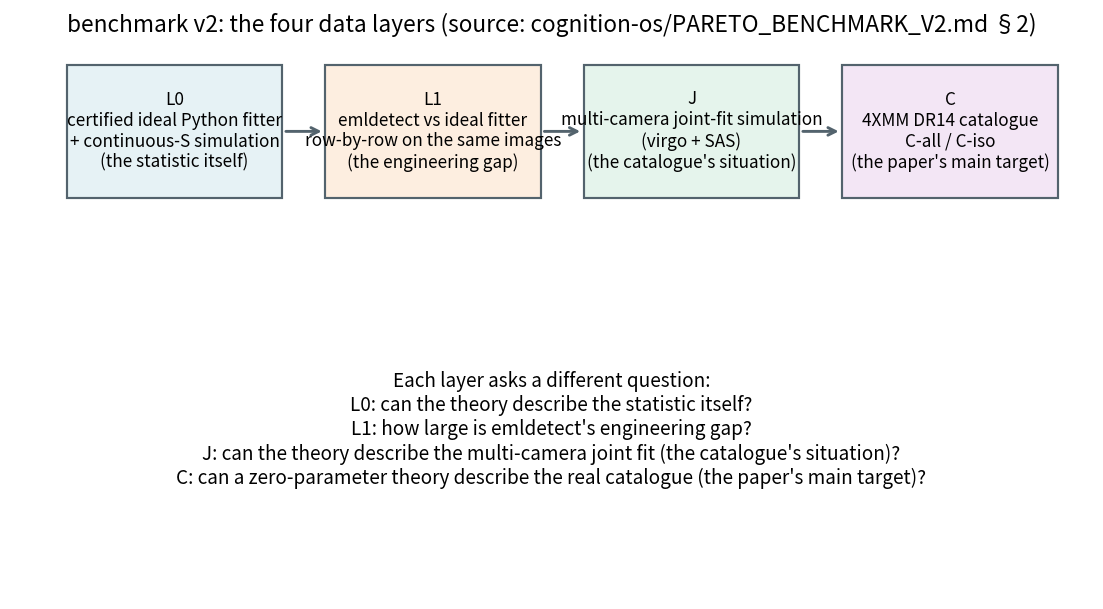
我们的路线:可控模拟,逐层隔离——统计量本身(L0)、SAS 流水线(L1)、联合拟合(J)、目录(C)。[s4]Our route: a controlled simulation, isolated layer by layer — the statistic itself (L0), the SAS pipeline (L1), the joint fit (J), the catalogue (C).[s4]
为什么不直接在真实数据上校准?重复指向和注入源当然宝贵,但它们同时改变四个东西:仪器、背景、源群、流水线。你问“宽度差多少”,有答案;你问“为什么差”,四个因子纠缠在一起,没有答案。我们走另一条路:可控的模拟基准,把问题切成层。看这张图:最底层 L0 是我们自己的拟合器,只测统计量本身;往上一层 L1 是 SAS 的 emldetect,加进真实流水线的工程;再往上 J 是联合拟合——十五幅图像共用一个位置;最后才对目录 C。每层只有一个东西在变,每个差异都能追到具体的环节。今天讲的是最下面两层。一句话总结这一页:模拟不是替代真实数据,是把“为什么”从“差多少”里剥出来的唯一办法。下一页讲构造的具体成分。
Why not just calibrate on real data? Repeat pointings and injected sources are of course valuable, but they change four things at once: the instrument, the background, the source population, and the pipeline. Ask "how much does the width differ" and you get an answer; ask "why does it differ" and the four factors are entangled and you get nothing. We take a different road: a controlled simulation benchmark that slices the problem into layers. Look at the figure: at the bottom, L0 is our own fitter, measuring the statistic itself and nothing else. Above it, L1 is SAS's emldetect, adding the engineering of a real pipeline. Above that, J is the joint fit — fifteen images sharing one position. Only at the end, C, the catalogue. One thing changes per layer, so every difference can be traced to a specific step. Today's talk lives in the bottom two layers.One sentence for this page: simulation is not a replacement for real data — it is the only way to peel "why" apart from "how much". The next page gives the concrete ingredients of the construction.
cumulative 13.0 min
结果二:目录区间里,同一公式在真实 PSF 下系统性偏窄Result two: in the catalogue interval the same formula is systematically narrow under the real PSF
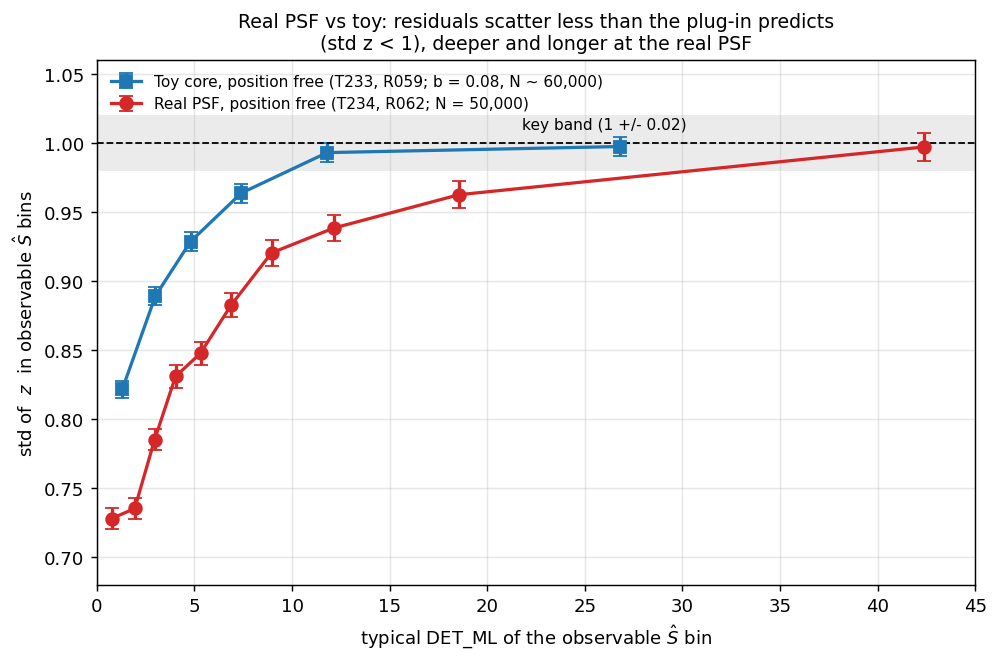
合并 std z 0.840 / 0.894 / 0.909 / 0.959 / 0.984 于 DET_ML \(\approx\) 4.6 / 7.9 / 11.1 / 22.8 / 36.8;约 36–60 才回到 1。玩具(蓝)约 12 就消失。[s9]Pooled std z 0.840 / 0.894 / 0.909 / 0.959 / 0.984 at DET_ML \(\approx\) 4.6 / 7.9 / 11.1 / 22.8 / 36.8, returning to 1 only by about 36–60; the toy (blue) is gone by about 12.[s9]
第二条结果。看这张图:横轴是每箱的典型检测似然,纵轴是标准差比,灰色带是判据带一点加减零点零二,误差棒是标准误。红圈是真实 PSF:从左到右,检测似然约五时只有零点八四,七点九时零点八九,要到三十六以上才回到一。蓝方是玩具高斯 PSF:同样的构造,偏窄到十二就消失了。所以这不是“低计数总是偏窄”的普通现象:它是真实 PSF 的核翼结构带来的,比玩具更深、更持久。这条规律与源计数先验无关,在六十七个位置上都成立。如果你在做弱源目录,这是你今天要记住的问题。还要注意偏窄的方向:分母被高估,残差被除得太狠,所以误差棒偏小、完备性偏高——它让目录看起来比实际更好,这是最危险的方向。
Second result. Look at this figure: the horizontal axis is the typical detection likelihood of each bin, the vertical axis the standard-deviation ratio, the grey band is the key band of one plus or minus zero point zero two, and the error bars are standard errors. The red circles are the real PSF: reading left to right, only zero point eight four at detection likelihood about five, zero point eight nine at seven point nine, and not back to one until past thirty-six. The blue squares are a toy Gaussian PSF: the same construction, and its narrowing is gone by twelve. So this is not the generic "low counts are always narrow": it is brought by the real PSF's core-and-wing structure, deeper and longer-lasting than the toy. The law is independent of the source-count prior and holds at all sixty-seven positions. If you make faint-source catalogues, this is the problem to remember from today. Note also the direction of the narrowing: the denominator is over-stated, the residuals are divided too hard, so the error bars come out small and the completeness high — it makes a catalogue look better than it is, which is the most dangerous direction.
cumulative 23.0 min
同一个机制也决定 emldetect 的宽度——两条流水线,一个机制The same mechanism sets emldetect's width too — two pipelines, one mechanism
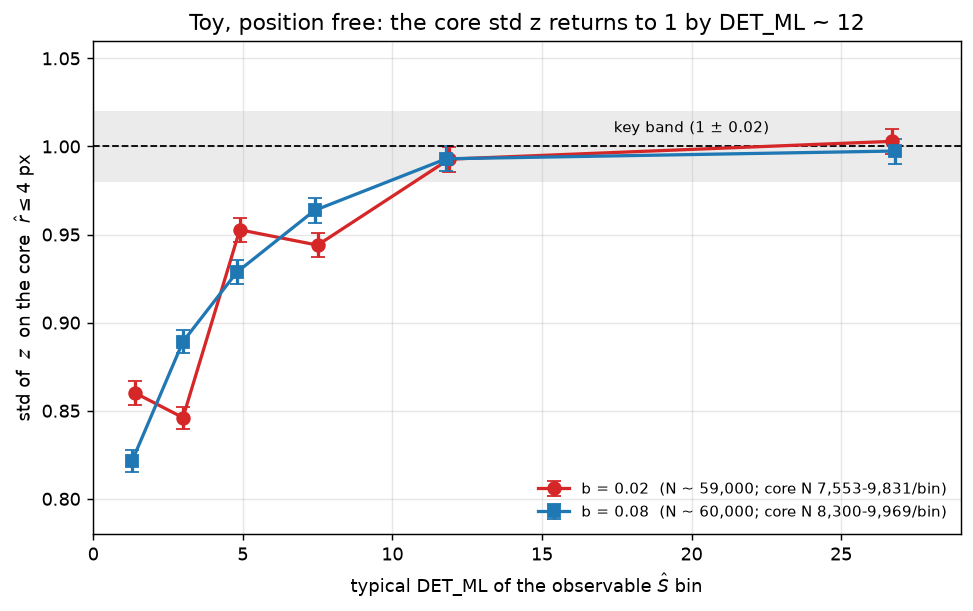
emldetect(L1):DET_ML 6–10 错配 +1.19 % [+1.03, +1.35](合并估计量),解释箱内宽度缺口的 0.89 [0.84, 0.93];预测 std z 0.919 对实测 0.918(按行合并 0.940)。[s13]emldetect (L1): DET_ML 6–10 mismatch +1.19 % [+1.03, +1.35] with pooled estimators, explaining 0.89 [0.84, 0.93] of the within-cell width deficit; predicted std z 0.919 against the observed 0.918 (row-pooled 0.940).[s13]
这一页是最近的一条结果,也是把故事合上的一页。看图:横轴还是典型检测似然,纵轴是标准差比;这是玩具核的曲线,emldetect 的对应表现在备用页里。emldetect 的宽度也偏窄——标准差比零点九四六。用合并估计量重测它的 penalty 错配:加百分之一点一九,区间一点零三到一点三五。把这个错配放进同一个相消机制,预测标准差比零点九一九——实测零点九一八。也就是说,同一个机制解释了 emldetect 宽度缺口的百分之八十九。早先一个“emldetect 的错配约等于零”的读数,是逐格比值再取平均造成的——逐格平均会让格间散布吃掉信号;合并估计量才保留它。所以结论统一了:不是“我们的拟合器一个物理、emldetect 另一个物理”,是两条流水线共享一个机制。这也是为什么我说修一次两边都受益。
This page carries the most recent result, and it closes the story. Look at the figure: the horizontal axis is again the typical detection likelihood, the vertical axis the standard-deviation ratio; this curve is the toy core, and emldetect's corresponding table is in the backup pages. emldetect's width is narrow too — a standard-deviation ratio of zero point nine four six. Re-measuring its penalty mismatch with pooled estimators gives plus one point one nine per cent, interval one point zero three to one point three five. Feeding that mismatch through the same cancellation mechanism predicts a standard-deviation ratio of zero point nine one nine — the observation is zero point nine one eight. In other words, one mechanism explains eighty-nine per cent of emldetect's width deficit. An earlier reading that "emldetect's mismatch is about zero" came from averaging per-cell ratios — a per-cell average lets the between-cell scatter eat the signal; pooled estimators keep it. So the conclusion is unified: it is not "our fitter has one physics and emldetect another" — the two pipelines share one mechanism. And that is why I said fixing it once benefits both.
cumulative 34.0 min
低计数端的中心项也偏高——它是 L0 流水线自己的性质,成因开放At the low-count end the centre term is biased high too — a property of the L0 pipeline itself, cause open
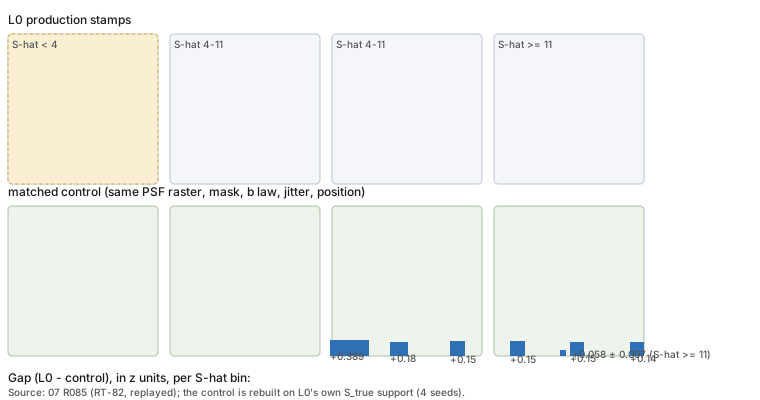
匹配对照下差距仍在:\(\hat{S}\) 分箱 +0.389 / +0.14–0.18 / +0.058 \(\pm\) 0.007;但 72/28 归因已撤回(配对重拟合只补 0–27 %),成因开放。[s14]The gap survives the matched control: \(\hat{S}\)-bin gaps +0.389 / +0.14–0.18 / +0.058 \(\pm\) 0.007; but the 72/28 attribution is withdrawn (the paired refit closes only 0–27 %), cause open.[s14]
宽度之外还有中心。低计数端,条件均值也偏高。看这张图:上排是 L0 生产的真实 PSF 图像,下排是匹配对照——同样的 PSF 栅格、掩膜、背景律、抖动、位置;黄色带标出低计数箱;右侧的条是按可观测量分箱的差距,单位是标准差。差距还在:最低计数箱高零点三八九,中间箱零点一四到零点一八,高计数箱零点零五八加减零点零零七。对照这一侧本来就是我们自己的仪器,所以这个差距量的是 L0 流水线自己的性质,不是 emldetect 的物理。但要诚实:它具体来自模板族、拟合器还是插值约定,现在开放——我们曾把它拆成七成二对二成八,后来用配对重拟合检验这个拆分,它只能补上百分之零到二十七,拆分撤回。同图同打分的配对实验也已完成:同一批图像上 emldetect 与 L0 高计数一致,DET_ML ≲ 7 处 emldetect 的中心反而比 L0 低 0.16–0.53 z、宽 0.05–0.14——所以这个超额不是 emldetect 的性质。超额本身站得住,成因未定。
Beyond the width there is the centre. At the low-count end the conditional mean is biased high too. Look at the figure: the top row is the L0 production real-PSF images, the bottom row the matched control — the same PSF raster, mask, background law, jitter and position; the yellow band marks the low-count bin; the bars on the right are the gaps in observable bins, in standard-deviation units. The gap survives: zero point three eight nine high in the lowest-count bin, zero point one four to zero point one eight in the middle bins, zero point zero five eight plus or minus zero point zero zero seven in the high-count bin. The control side is already our own instrument, so the gap measures a property of the L0 pipeline itself, not emldetect physics. But to be honest: whether it comes from the template family, the fitter or the interpolation conventions is open — we once split it seventy-two against twenty-eight per cent, then tested that split with a paired refit, which closes only zero to twenty-seven per cent, so the split is withdrawn. The paired same-images-same-scoring run is completed too: on the same images emldetect and L0 agree at high counts and at DET_ML ≲ 7 emldetect's centre is 0.16–0.53 z lower and its width 0.05–0.14 larger than L0 — so this excess is not an emldetect property. The excess stands; its cause is undetermined.
cumulative 36.5 min
B4 · 位置混合:按拟合偏移分箱,均值从 +0.26 降到圆壁处的 −2.76Position mixture: in fitted-offset bins the mean runs from +0.26 down to −2.76 at the wall
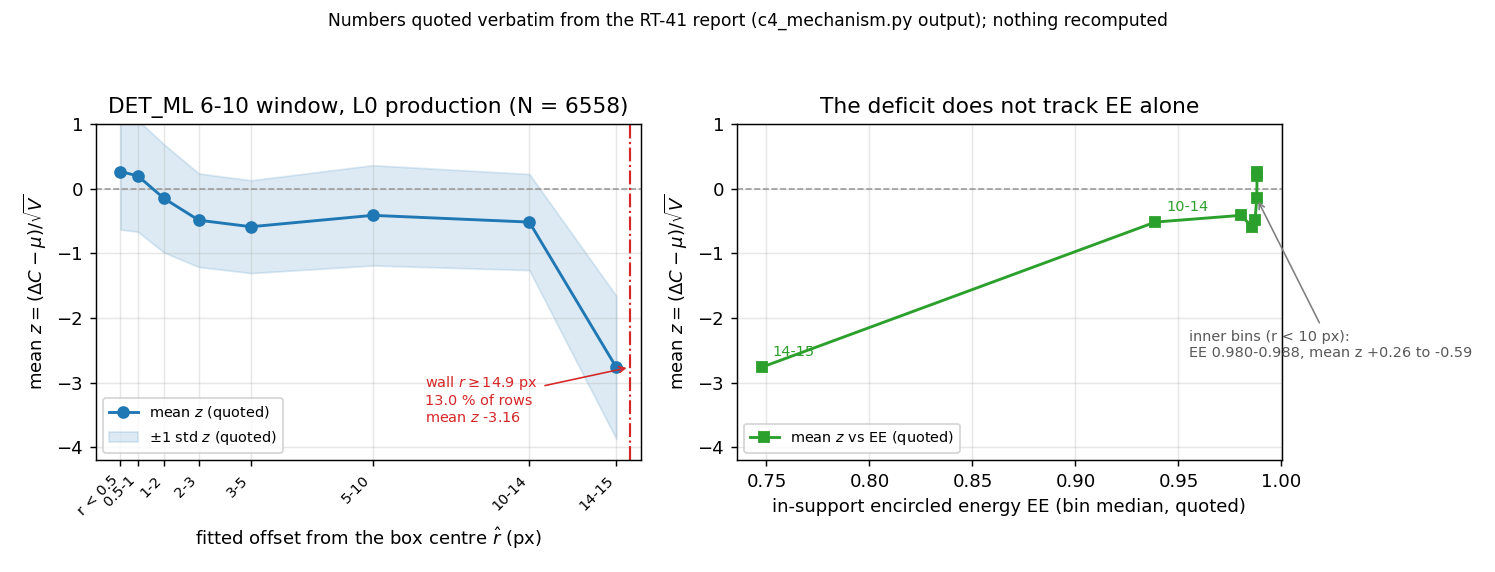
L0 生产表 DET_ML 6–10 窗口,按 \(\hat{r}\) 分箱的 \(z\) 均值;\(\hat{r} \gtrsim\) 14.9 px 处骤降(支撑墙)。[s16]The L0 production table's DET_ML 6–10 window, \(z\) means in \(\hat{r}\) bins; a sharp drop at \(\hat{r} \gtrsim\) 14.9 px (the support wall).[s16]
(备用页。)
(Backup.)
cumulative 46.5 min
B5 · 先验作用域:宽度与先验无关(\(\leq\) 0.6 SE),均值要源计数先验Prior scope: the width is prior-independent (\(\leq\) 0.6 SE), the mean needs the source-count prior
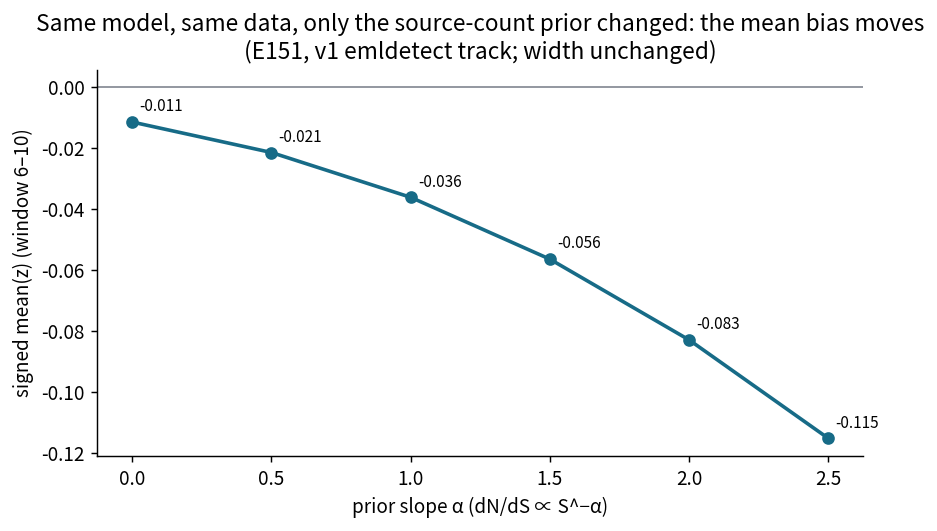
先验扫描:宽度不变,均值随 \(\alpha\) 单调移动——这就是条件律要带 index 变量的原因。[s17]A prior scan: the width is unchanged while the mean moves monotonically with \(\alpha\) — the reason the conditional law carries an index variable.[s17]
(备用页。)
(Backup.)
cumulative 46.5 min
预期问答(10–15 分钟)Anticipated Q&A (10–15 minutes)
- “为什么不直接在真实 XMM 观测上做?”"Why not just do this on real XMM observations?" 真实数据同时变仪器、背景、源群、流水线,四个因子纠缠;模拟基准让每层只有一个变量。配对实验(同图同打分)已经完成:它回答“拟合器贡献多少”的方式,是证明 L0 的低计数超额不是 emldetect 的性质——所以单图 emldetect 规律要在 emldetect 自己的输出上建。(用 B1。) Real data change instrument, background, population and pipeline at once — four entangled factors; the benchmark isolates one per layer. The paired run (same images, same scoring) is completed: it answers "how much is the fitter" by showing the L0 low-count excess is not an emldetect property — so the single-image emldetect law must be built on emldetect's own output. (Uses B1.)
- “把 \(\sqrt{V}\) 换成模拟校准表不就行了?”"Why not just replace \(\sqrt{V}\) with a simulation-calibrated table?" 这正是实用路线;但要报告校准的来源与适用区间,且不能跨流水线搬。我们的贡献是告诉你表必须随 (计数, 背景, PSF) 变——因为机制如此。(用 B2、B3。) That is the practical route; but the calibration's source and interval must be reported, and it must not be carried across pipelines. Our contribution is telling you the table must vary with counts, background and PSF — because the mechanism does. (Uses B2, B3.)
- “这个 1 % 错配是不是你们打分方式的伪迹?”"Is this 1 % mismatch an artefact of your scoring?" 它随 PSF 的翼结构走、随计数走,在两条独立流水线上都出现,且 emldetect 侧解释 0.89 的缺口——伪迹不会这样跨流水线自洽。同图同打分的配对实验已经完成,它确认了这个超额不是 emldetect 的性质。(用 B6。) It follows the PSF's wing structure and the counts, appears in both pipelines independently, and explains 0.89 of the deficit on the emldetect side — an artefact would not be cross-pipeline self-consistent. The paired same-images-same-scoring run is completed and confirms the excess is not an emldetect property. (Uses B6.)
- “为什么之前测到 emldetect 错配约等于零?”"Why was emldetect's mismatch previously measured as about zero?" 逐格比值再取平均被格间散布支配;合并估计量保留信号。同一批数据、两种估计量,差不是涨落(恒等式闭合到 1e-15)。(用 B6。) Averaging per-cell ratios lets the between-cell scatter dominate; pooled estimators keep the signal. Same data, two estimators — the gap is not a fluctuation (the identity closes to 1e-15). (Uses B6.)
- “结果对其他场、其他能段普适吗?”"Does this generalise to other fields and bands?" 机制(相消放大)应当普适,因为它只依赖方差公式是两项之差;错配的数值不普适——它随 PSF 翼结构与计数变。所以条件律产品按 3 仪器 × 5 能段做,每格自己校准。(用 B3。) The mechanism — cancellation amplification — should generalise, since it only needs the variance to be a difference of two terms; the mismatch's value does not, as it follows the PSF's wings and the counts. Hence the conditional-law product is built per 3 instruments × 5 bands, each cell calibrated on its own. (Uses B3.)
- “位置自由会不会才是罪魁?”"Isn't the free position the real culprit?" 位置自由不改变宽度,但带来中心项问题:按拟合偏移分箱,均值从 +0.26 平滑下降到支撑墙处的 −2.76。宽度与中心是两个可分离的问题。(用 B4。) A free position leaves the width unchanged but brings the centre term: in fitted-offset bins the mean runs from +0.26 down to −2.76 at the support wall. Width and centre are separable problems. (Uses B4.)
- “均值那边怎么办?宽度讲了半天。”"What about the mean? This was all width." 均值需要源计数先验(宽度不需要):先验扫描里宽度不动、均值随斜率单调移动。这就是条件律带 index 变量的原因——弱源处对真实流量的依赖经斜率表达。(用 B5。) The mean needs the source-count prior (the width does not): in prior scans the width is fixed while the mean moves monotonically with the slope. That is why the conditional law carries an index variable — the faint-end dependence on the true flux is expressed through the slope. (Uses B5.)
- “覆盖率受多少影响?”"How much does coverage suffer?" 净效应只有 +2–5 pp 过覆盖,因为宽度项与中心项相消;只修宽度反而欠覆盖 −2.9 pp。所以目标是联合校准到 2 pp。(用 B7。) The net effect is only +2–5 pp over-coverage, because the width and centre terms cancel; closing the width alone under-covers by −2.9 pp. Hence the joint 2 pp goal. (Uses B7.)
- “为什么不拟合一个二阶修正项?”"Why not fit a second-order correction term?" 试过:解析候选拒绝(Bartlett 符号反、beyond-Fisher 过修 1.3–7.4 倍且低计数出负方差)。拟合一个项当然可以,但那变成经验校准,而且必须逐 (计数, 背景, PSF) 格做——零参数路线到此为止是负结果。(用 B2。) Tried: analytic candidates are rejected (Bartlett wrong sign; beyond-Fisher over-corrects 1.3–7.4× and gives negative variance at low counts). Fitting a term is of course possible, but that is empirical calibration and must be done per counts-background-PSF cell — the parameter-free route ends in a negative result here. (Uses B2.)
- “这些结论的统计把握多大?”"How statistically solid are these conclusions?" 每箱 \(\geq\) 10,000 行、判据 \(1 \pm 0.02\) 预注册;关键数字带区间(如 +1.19 % [+1.03, +1.35]、0.89 [0.84, 0.93]);每条记录级结论有一次独立复算。红队专门攻击过这些推导,其中一次推翻了我们自己的读数(逐格平均那条)。(用 B6。) At least 10,000 rows per bin, a pre-registered \(1 \pm 0.02\) key; headline numbers carry intervals (e.g. +1.19 % [+1.03, +1.35], 0.89 [0.84, 0.93]); every record-grade conclusion has an independent replay. Red teams attacked these derivations specifically and once overturned our own reading (the per-cell average). (Uses B6.)
- “目录用户明天能拿走什么?”"What can a catalogue user take away tomorrow?" 三条规则:DET_ML \(\geq\) 50 直接用公式;6–20 用按 \(\hat{S}\) 分箱的经验校准并报告来源;跨流水线先做同图同打分配对比较。条件律产品在制。(用主报告第 21 页。) Three rules: above DET_ML 50 use the formula; in 6–20 use the per-\(\hat{S}\)-bin empirical calibration and report its source; across pipelines run the paired same-image comparison first. The conditional-law product is in progress. (Uses slide 21.)
- “你们怎么知道不是打分器又在骗人?”"How do you know the scorer is not fooling you again?" 因为它今天错了两次,都是我们自己抓出来并修好的:一次是零假设的通过率没算对(一条完美规律平均也只通过约 61/72,所以 10/72 远在噪声底之下),一次是全局统计量的尺度错了(288 项的观测统计量对 72 项的零假设,p = 0.000 不是 p 值)。修好之后,评分器先在“规律恰好为真”的合成数据上验证(p 值均匀,K-S p 0.59),再打分。这也是我们强调的方法学:先验证打分器,再谈结论。(用 B6。) Because it was wrong twice today, and both times we caught and fixed it ourselves: once on the null's pass rate (a perfect law passes only about 61/72 on average, so 10/72 is far below the noise floor) and once on the global statistic's scale (a 288-term observed statistic against a 72-term null, so p = 0.000 is not a p-value). After the fixes, the scorer is validated on synthetic data where the law is exactly true (uniform p, K-S p 0.59) before it scores anything. That is the methodology we stress: validate the scorer first, then draw conclusions. (Uses B6.)
- “还有什么你不知道的?”"What do you still not know?" 四件:条件律的中心项——四个候选形式全部被拒,宽度一半在同一个位置内可推广而中心一半不能(宽度指标对逐位置偏移恒等不变,1e-15),且位置不是缺失的变量;低计数中心项超额的成因(72/28 拆分已撤回,配对实验已证明它不是 emldetect 的性质);按计数修正的 \(V_{3p}\) 在 emldetect 输出上校准时给留出 0.976 [0.956, 0.993](一次偏低的分半,40 个分半平均 0.998),但换独立模拟仍过修;规律能否迁到其他能段(能段 1 上重拟合 37/72,原样迁移 17/72;新打分手给出能段 1 的 D / H2 通过 36 / 43 格)。我们如实标开放。 Four things: the conditional law's centre term — all four candidate forms are rejected, the width half generalises within one position while the centre half does not (the width metric is identically invariant to per-position offsets, 1e-15), and position is not the missing variable; the cause of the low-count centre excess (the 72/28 split is withdrawn and the paired run has shown it is not an emldetect property); the count-corrected \(V_{3p}\), which gives a held-out 0.976 [0.956, 0.993] when calibrated on emldetect output (one low split — 0.998 averaged over 40 splits) but still over-corrects when transferred from an independent simulation; and whether the law transfers to other bands (on band 1 the refit passes 37/72 and the unchanged transfer 17/72; the new scorer gives band-1 D / H2 36 / 43). We keep them labelled open, honestly.
- “你说‘已解决位置的比例’——现在怎么量、量到多少?”“You say ‘the solved fraction of positions’ — how is it measured now, and where does it stand?” 判据本身被校准过一次:“每个条目都在容差 \(\varepsilon\) 内”是噪声受限的——一条完美规律在能段 4 上也只能让 21–27 % 的位置满足它,因为每个条目自身的抽样误差约 0.12 z,而位置效应本身是 0.14 z。所以现在每个位置只报一个合并偏移,容差比较规律用 0.05、跟踪进度用 0.10,打分手冻结(18 个格、位置真值校准的 95 % 区间)。在这把尺子上,最好候选在 0.10 处是 0.545,高于改正后的地板 0.469;加上第一个拟合前位置项(拟合盒背景水平)到 0.727(p 0.003–0.004),但那是同一批位置的拟合并打分,尚未在新位置检验。还有一个必须连带的限制:冻结打分手的宽度区间欠覆盖(0.941 / 0.946 对一个 0.950 的接受带),所以任何比例都要连这个区间一起引用。(用主报告第 19 页。) The criterion itself was calibrated once: “every entry within the tolerance \(\varepsilon\)” is noise-limited — even a perfect law satisfies it at only 21–27 % of positions on band 4, because each entry's own sampling error is about 0.12 z while the position effect itself is 0.14 z. So each position now reports one pooled offset, with tolerances of 0.05 to compare laws and 0.10 to track progress, and the scorer is frozen (18 cells, position-true-calibrated 95 % intervals). On that ruler the best candidate sits at 0.545 at 0.10, above the corrected floor of 0.469; adding the first pre-fit position term (the fit-box background level) takes it to 0.727 (p 0.003–0.004), but that was fitted and scored on the same positions and is not yet tested on fresh ones. One limit must travel with every such number: the frozen scorer's width interval under-covers (0.941 / 0.946 against a 0.950 acceptance band), so any fraction is quoted together with that interval. (Uses slide 19.)
来源对照表Source Map
| 标记Marker | 记录Record |
|---|---|
| [s1] | cognition-os/CLAUDE.md — DET_ML Convention; Catalog Convention Traps (I041) |
| [s2] | physics.html §5 (boundary-corrected null law) |
| [s3] | 07_REVISION_LOG.md R030 (Ŝ-binning artefact withdrawn) |
| [s4] | cognition-os/PARETO_BENCHMARK_V2.md |
| [s5] | 07_REVISION_LOG.md R062; reviews/RT-58_triage_claude.md |
| [s6] | 07_REVISION_LOG.md R067; reviews/RT-64_triage_claude.md |
| [s7] | cognition-os/CLAUDE.md — IRON RULE (ML Analysis Methodology) |
| [s8] | 07_REVISION_LOG.md R076 |
| [s9] | 07_REVISION_LOG.md R062, R065; reviews/RT-62_triage_claude.md |
| [s10] | 07_REVISION_LOG.md R068, R072, R080 |
| [s11] | 07_REVISION_LOG.md R077; reviews/RT-72_triage_claude.md |
| [s12] | 07_REVISION_LOG.md R078, R080, R081 |
| [s13] | 07_REVISION_LOG.md R086 (reversing R083); reviews/RT-81_triage_claude.md |
| [s14] | 07_REVISION_LOG.md R082, R084, R085, R087 |
| [s15] | 04_DECISION_LOG.md 2026-10-20 04:51 EDT (main line and domain) |
| [s16] | 07_REVISION_LOG.md R075, R076 |
| [s17] | 07_REVISION_LOG.md R063; reviews/RT-59_triage_claude.md |
| [s18] | 07_REVISION_LOG.md R073 |
| [s19] | 07_REVISION_LOG.md R093–R104 (the law stage: LAW-1/2/3/4, M2B1, D-M2B1, NULL-1, RT-87–RT-94, CENTRE-POS) |
| [s21] | 07_REVISION_LOG.md R125–R156 (the 2026-10-22 re-calibration: the pooled-offset criterion and the frozen scorer, the floor correction, the pixel-geometry position effect, the first pre-fit position term, the calibrated width rule and the observable bin-level law, the width-CI coverage limit, the error-compensation reading, the 1.16 arm ratio); R157–R161 (the cluster-SE and seed-luck withdrawals, the Tier 0 band/instrument FAIL (withdrawn in R162) and catalogue-axis PASS within domain, the coarse-anchor re-interpretation, the B011 sign defect at 0 % of the failures); 04_DECISION_LOG.md 2026-10-22 (the PI's tolerances and the universality order); R162–R185 (the Tier 0 convention correction and A0-RESCORE, the fine width anchors and the cluster-bootstrap CI, the catalogue \(\mu_0\) domains and bias forms, the fresh-position AMBIGUOUS verdict and the crowding, the width-rule null recalibration, the mask rule, the three M1 positions, the clean population, and the revised Tier 1 plan); R189–R229 (the T1-e held-out block scoring and its three separate verdicts, the background channel's non-universality and candidate C2, the cost-anchor correction and the T1-a launch, the catalogue tautology, the broken power law and the eta amplitude, the refuted PSF-weighted reference, and the withdrawn cross-fit inflation) |
| [s20] | 07_REVISION_LOG.md R114–R120 (the 2026-10-21 re-scoping: R114 the expert's estimand critique, R115 the width split ensemble, R116 the centre decomposition, R117 RT-98's width-invariance result, R118 SCORER-CONTRACT v2's two targets, R119 RT-101's seed-range qualification, R120 RT-100's first progress point) |
致谢:本页的整理工作由 AI 代理完成(按 AAS 政策声明)。基于 XMM-Newton(ESA 科学任务,仪器与贡献由 ESA 成员国与 NASA 直接资助)的模拟构造。Acknowledgments: AI agents assisted in preparing this page (stated per AAS policy). The simulation construction is based on XMM-Newton, an ESA science mission with instruments and contributions directly funded by ESA Member States and NASA.